
Cost of IVF Worldwide: Where It’s Most Affordable takes an in-depth look at how IVF expenses differ across the globe and where couples can find the best balance between quality and affordability. The cost of in vitro fertilization (IVF) can vary dramatically depending on the country, clinic standards, and included services such as medications, lab procedures, and embryo transfers.
This comprehensive guide compares global IVF prices in popular fertility destinations like India, Georgia, Mexico, the USA, and several European countries, helping intended parents make informed choices about where to pursue safe, effective, and budget-friendly fertility treatment.
Key Takeaways
- Global IVF pricing varies greatly; some countries offer much lower headline prices than the U.S., but final costs often rise with add-ons.
- Compare clinics using transparent, line-by-line quotes and clinical quality indicators—not just the headline price.
- Major cost drivers include medications, laboratory procedures, freezing/storage, and donor materials.
- Typical European ranges: own-egg IVF, approximately €2,100–€6,700; donor-egg cycles, approximately €4,000–€8,500 (USD varies with exchange rates).
- Consider legal, regulatory, and travel logistics when evaluating international options for true cost-effectiveness.
📞 Get in Touch for a Free Surrogacy Consultation
📱 +91-8800481100 (WhatsApp | LINE | Viber)
📧 neelam@ivfconceptions.com
🌐 www.georgiasurrogacyagency.com
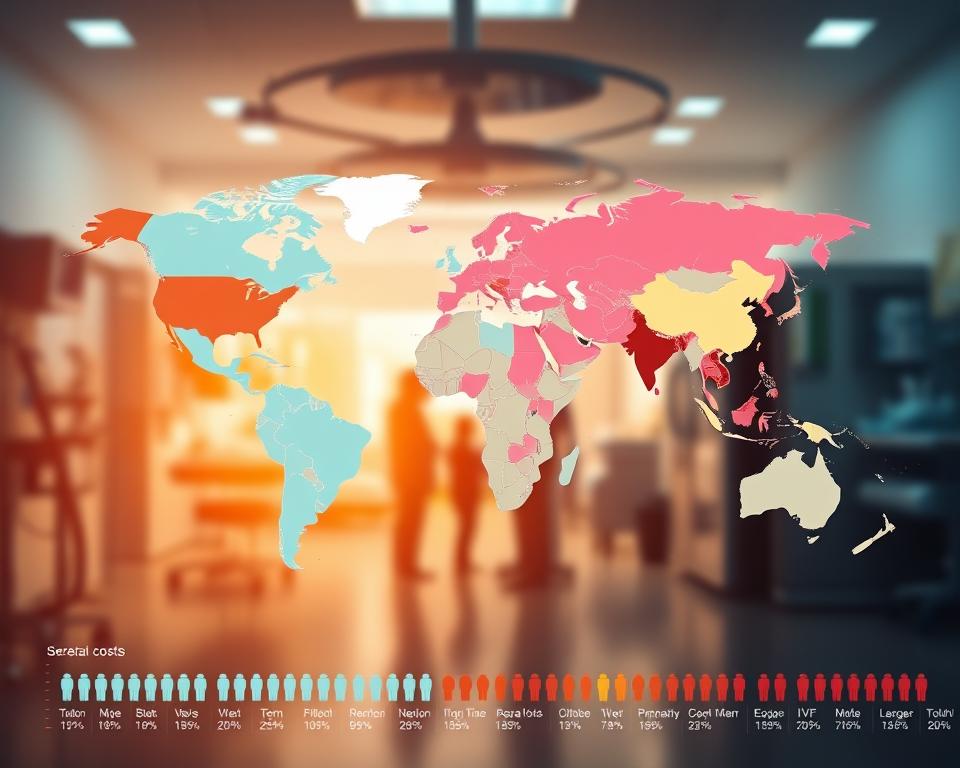
Global snapshot of IVF pricing and affordability
People often wonder about the cost of IVF treatments. The prices vary a lot depending on the location, clinic, and services offered. It’s best to look at the initial prices as a starting point, not the final cost.
Here are some typical price ranges for different regions. These ranges help you compare IVF costs across countries, including travel and medication expenses.
Middle East & Asia. Iran offers very low-cost IVF, starting at around $1,200. India has basic IVF for $2,000–$3,500, ICSI for $3,000–$4,000, and donor egg for $3,500–$5,000. Turkey’s prices are $2,200–$4,000 for standard cycles and $4,000–$6,000 for donor egg programs.
Thailand and South Korea have higher prices. South Korea quotes $4,000–$6,000 for basic care and $6,000–$8,500 for IVF with genetic testing. These prices show the affordable options in Asia.
North America. The United States is usually the most expensive. Many U.S. patients look for cheaper options abroad to save money without sacrificing quality.
Latin America. Mexico offers basic cycles for $3,500–$5,000 and donor egg for $4,500–$7,000. Brazil has similar prices for standard IVF and donor egg. Colombia is a bit cheaper, with basic cycles at $3,000–$4,500. These countries offer affordable IVF options for both locals and tourists.
Europe. Prices vary from low to mid-range. The Czech Republic and Poland have basic cycles for €2,100–€3,500 and €2,200–€2,500, respectively. Greece quotes €2,500–€3,500.
Spain’s prices are €3,600–€6,700, with donor programs at €5,900–€8,500. Portugal and Denmark offer mid-range cycles for €4,000–€4,600 and €3,300–€4,500. Eastern European countries like Ukraine, Latvia, and Russia have prices from €1,500 to €3,600 for own-egg and donor-egg treatments. These prices help find the cheapest IVF options in Europe.
Advertised prices often don’t include everything. Clinics usually offer a basic package that covers some costs. But there are often extra fees for medications, ICSI, genetic testing, and more.
Items like stimulation medications, ICSI, PGT, and frozen embryo transfers can increase the total cost. Donor gamete purchase, couriering, and egg-bank fees also add up. Looking at packages or refund programs can help, but read the fine print carefully.
Here’s a tip: always ask for a detailed quote that shows what’s included and what’s extra. This way, you can compare prices better and avoid surprises.
Key cost drivers for IVF: what increases the bill
The cost of IVF can vary a lot. This is because many things are not included in the initial quote. Knowing what these are helps you compare prices, find hidden fees, and plan better for IVF expenses.
Medications and stimulation are big costs. Drugs like gonadotropins and trigger injections are often not included in the initial price. The cost depends on your age and how many eggs you have. Younger people with more eggs usually pay less.
Ask clinics about the medications they use, how much you might need, and the prices. This way, you can compare costs more accurately.
Labor costs and extra services also vary. Some clinics include ICSI in their packages, while others charge extra. Services like advanced culture, time-lapse monitoring, and genetic testing can increase the cost. PGT-A, or genetic screening, can add thousands of dollars to your bill.
Freezing and storing embryos can lead to ongoing costs. The initial freezing and storage may be charged separately from the renewal fees. FET cycles, or frozen embryo transfers, are often not included in the initial price. Make sure to budget for these and the medications needed.
Donor eggs and external bank fees add to the cost. Donor-egg programs usually cover the donor’s fees and basic lab work. But buying eggs or embryos from outside banks can lead to extra charges. Make sure to compare these programs carefully when looking for affordable options.
To avoid unexpected costs, ask for a detailed quote and find out what extra charges might apply. Also, get written confirmation on storage and FET inclusion. This helps you compare costs better and find real savings without sacrificing quality.
| Cost Element | Typical Range (U.S. context) | Notes for comparison |
|---|---|---|
| Stimulation medications | $1,000–$5,000 | Depends on protocol, age and ovarian reserve; often excluded from base quote |
| ICSI | $500–$2,000 | May be standard or optional; essential for most severe male factor cases |
| PGT-A (genetic testing) | $3,000–$7,000 | Significantly raises total cost; useful for recurrent loss or advanced maternal age |
| Embryo freezing | $500–$1,500 | Initial vitrification often separate; check included storage period |
| Storage renewal (annual) | $200–$800 | Fees accumulate over years; confirm policy and caps |
| FET cycle | $500–$2,500 | May exclude medications; multiple transfers increase lifetime spend |
| Donor eggs (external bank) | $250–$450 per egg | Sold in batches; transport, legal and quarantine add costs |
| Donor embryo programs | $1,400–$5,000 | Ranges vary widely by country and clinic; review what is included |
Where are the most affordable IVF destinations located
Patients looking for the cheapest IVF countries weigh price against clinic quality and legal standards. They compare fees, donor access, and local laws before picking a place. Low-cost clinics can cut costs, but total expenses include meds, travel, and storage fees.
Top low-cost countries and typical ranges
Iran is often the cheapest for IVF, with basic cycles around $1,200 and total costs up to $2,500 with tests. Egg donation in Iran varies, usually between $1,500 and $6,000.
India is another popular choice for affordable IVF clinics, with basic cycles around $2,000–$3,500. Donor-egg programs cost $3,500 to $5,000, and IVF with PGT is $4,000–$6,500. Many clinics in Mumbai and Delhi offer packages for international patients.
Turkey, mainly Istanbul, offers competitive prices at about $2,200–$4,000 for a standard cycle. Donor egg treatments commonly cost $4,000–$6,000. Clinics often include transfers and consultations in patient packages.
Mexico attracts North American patients with short flights and bilingual staff. Basic IVF rates are $3,500–$5,000. Donor-egg cycles are $4,500–$7,000. Care in Mexico requires attention to legal and travel logistics.
Eastern European options include Ukraine, the Czech Republic, and Poland. Czech Republic clinics list own-egg cycles near €2,100–€3,500. Poland offers cycles around €2,200–€2,500. These centers are often cited among the cheapest IVF clinics in Europe.
Thailand, Colombia, and Brazil present mid-range low-cost IVF destinations, with standard cycles commonly between $3,000 and $5,000. Donor programs and genetic testing add to final costs in these markets.
Countries with mid-to-higher pricing but strong value
Spain and Portugal sit higher on price charts, yet they rank among the best countries for affordable ivf when quality and legal clarity are weighed. Own-egg cycles in Spain typically run €3,600–€6,700. Donor programs often cost €5,900–€8,500.
Greece combines liberal regulations and reputable labs. Own-egg cycles generally range €2,500–€3,500. Donor-egg programs are often €4,200–€6,000. Short waiting times for donors add practical value.
Denmark charges more per cycle—often €3,300–€4,500 for own-egg treatments—but maintains large donor banks and strict standards. Patients who need reliable donor access sometimes find Denmark’s higher prices worthwhile.
South Korea represents advanced technology with strong outcomes and higher costs in Asia. Typical cycles often exceed $4,000–$6,000. Many patients accept the premium for specialized services and documented lab performance.
When assessing low-cost ivf destinations, look beyond headline fees. Clinic reputation, embryology lab quality, donor bank access, and the legal environment shape both safety and future expenses. Choosing one of the cheapest countries for IVF can save money, provided you factor in medications, travel, legal steps, and possible repeat cycles.
Cost comparisons by treatment type and country

This section breaks down typical ivf cost by country and by treatment type so you can compare options clearly. Numbers below reflect common ranges reported across clinics in Europe, Asia, Latin America and the Middle East. Use these examples to gauge relative affordability and to plan follow-up costs like storage and FET.
Own-egg IVF ranges (examples from Europe and beyond)
In Europe, own-egg IVF can vary widely. The Czech Republic often lists €2,100–€3,500. Poland commonly posts €2,200–€2,500. Greece ranges from €2,500 €3,500. Spain and Portugal trend higher, with Spain €3,600–€6,700 and Portugal €4,000–€4,600. Denmark typically falls around €3,300–€4,500. Eastern Europe shows lower ranges: Ukraine €2,500–€3,200, Latvia €2,200–€3,600, and Russia €2,300–€2,900.
Across Asia and the Middle East, costs shift by clinic and service. Iran may offer a baseline near $1,200. India commonly reports $2,000–$3,500. Turkey often lists $2,200–$4,000. South Korea tends toward higher fees, around $4,000–$6,000. In Latin America, Mexico and Brazil frequently fall near $3,500–$5,000, with Colombia at $3,000–$4,500.
Donor-egg IVF and embryo donation price patterns
Donor-egg IVF cost shows a clear premium over own-egg cycles. In Europe, Spain frequently ranges €5,900 €8,500. The Czech Republic often lists €4,300–€5,500. Greece reports €4,200–€6,000. Poland and Portugal fall near €5,200–€6,000 and €6,300–€7,300, respectively. Denmark is higher, €7,000–€8,300. Russia and Ukraine tend to be lower, €4,000–€4,800 and €4,600–€5,500. North Cyprus commonly lists €4,500–€5,000.
Embryo donation price often undercuts donor-egg programs. Examples include Poland €1,400–€2,000, Ukraine €1,500–€2,200, Portugal €2,000–€2,400, Czech Republic €2,200–€3,500, Spain €3,000–€5,000, and Greece €3,500–€6,000. In Asia, India and Turkey report mid-single-thousands for donor cycles (India donor egg $3,500–$5,000; Turkey $4,000–$6,000). Iran offers lower donor egg prices ranging from $1,500 upward, depending on services.
Egg freezing, ROPA, and specialized services
Egg freezing cost varies by country and by whether storage and thawing are bundled. Examples in Europe: Poland €1,600–€2,200, Czech Republic €2,000–€3,000, Spain €3,500–€4,700, Denmark €3,200–€3,800, North Cyprus €2,500–€2,700, and Ukraine €2,100–€2,500.
ROPA (reception of oocytes by partner) is commonly offered in Spain (€5,000–€7,000) and Portugal (€4,700–€5,500). Denmark provides ROPA at higher ranges near €5,000–€7,800. Many clinics sell specialized add-ons such as PGT-A, minimum-blastocyst guarantees, and bundled donor packages with refunds or shared-risk terms. Verify eligibility rules and what triggers refunds before committing.
When reviewing IVF prices by country, compare inclusive bundles that state clearly which services are included: medication, monitoring, lab work, embryo storage, and FET. Ask clinics for a line-by-line quote so you can compare true IVF costs by country and avoid surprises.
| Treatment | Representative country | Typical range |
|---|---|---|
| Own-egg IVF | Czech Republic | €2,100–€3,500 |
| Own-egg IVF | Spain | €3,600–€6,700 |
| Own-egg IVF | India | $2,000–$3,500 |
| Donor-egg IVF | Spain | €5,900–€8,500 |
| Donor-egg IVF | Czech Republic | €4,300–€5,500 |
| Donor-egg IVF | Turkey | $4,000–$6,000 |
| Embryo donation | Poland | €1,400–€2,000 |
| Embryo donation | Spain | €3,000–€5,000 |
| Egg freezing | Poland | €1,600–€2,200 |
| Egg freezing | Spain | €3,500–€4,700 |
Use these ranges to judge value, not just headline price. Factor in travel logistics, local regulations, and clinic success data when comparing IVF prices by country. For ROPA or female-couple services, prioritize destinations with clear legal pathways and clinic experience.
How to compare clinics: finding affordable IVF options without sacrificing quality
Choosing a clinic means comparing facts clearly. Start by asking for a detailed, written estimate. This helps you accurately compare IVF costs. Clinics that aim to be the best value will give clear, itemized pricing and easy-to-understand explanations.
What to request in a line-by-line quote
- Itemize each service: consultations, scans, full lab testing, egg retrieval, fertilization, ICSI if used, embryo culture length (day 3 vs day 5), and transfer fees.
- List stimulation medications with estimated doses and costs, plus anesthesia and sperm processing fees.
- Detail cryopreservation, vitrification, and storage (state duration included) plus charges for first and additional FETs.
- Include genetic testing (PGT) fees and any administrative, legal, or donor-related expenses.
- Note variable charges: extra meds for poor responders, repeat retrieval or transfer fees, cryostorage renewal, and transport or quarantine costs for donor materials.
Evaluating bundled programs and shared-risk offers
- Confirm what a bundle covers: number of cycles, whether medications and FETs are included, and guarantees for donor oocytes or blastocysts.
- For shared-risk or refund plans, verify eligibility, precise outcome definitions (clinical pregnancy versus live birth), the number of failed cycles covered, and the refund formula.
- Read exclusions carefully. Some programs set age limits, ovarian reserve cutoffs, or exclude certain sperm or uterine factors.
Quality indicators beyond price
- Check embryology lab accreditation and available technology (time-lapse incubators, validated vitrification).
- Ask for age-stratified published success rates (live births per embryo transfer) and methods used to calculate them.
- Review clinical team credentials: board-certified reproductive endocrinologists and experienced embryologists matter.
- Evaluate patient support: counseling, international patient coordination, and clear post-treatment follow-up plans.
- Use patient testimonials and third-party reviews as context, but rely on data for comparisons among affordable IVF clinics and cost-effective IVF centers.
Actionable checklist: request a line-by-line pricing sheet, confirm accreditation and transparent success rates, verify donor and storage policies, and compare bundle eligibility carefully. A focused IVF cost comparison between clinics will reveal which affordable fertility clinics offer the best balance of price and quality.
Practical planning for U.S. patients considering IVF abroad
Traveling for IVF can save money, but it adds to the hassle. Start with a detailed budget for clinic fees and extra costs. Use this checklist to compare costs and avoid surprises.

Budgeting for travel, stay, and logistics
Plan for flights, clinic visits, and where to stay. Many clinics offer deals that include local transport and short stays. But, they might not cover all visits or delays.
Remember to include costs for medication, interpreter fees, and paperwork. Also, have extra money for unexpected delays. Mexico and parts of Latin America are often cheaper than Europe or Asia for U.S. patients.
Legal, regulatory, and eligibility considerations
Visa rules and medical visa processes change by country. Check the current entry requirements before booking. Surrogacy laws vary widely; some countries ban it or restrict who can use it.
Donor anonymity and registry standards also differ. Some countries allow anonymous donation, while others keep records. Make sure you understand how parental rights are established on return to the U.S.
Confirm if you meet the clinic’s age and medical criteria. Some countries have age limits or medical criteria for treatment. Ask for written policies before paying deposits.
When is international IVF cost-effective compared to the U.S?
Compare all costs: clinic fees, meds, travel, lodging, storage, and legal work. International care can save money, mainly when U.S. prices are high. Look for programs that include multiple cycles or offer refunds.
Donor gamete prices abroad can be a big savings. Countries like Iran or India have lower egg donation costs than the U.S. Weigh savings against travel stress, time off work, and continuity of care.
Plan with a detailed budget and check legal routes to parentage. Consult a U.S.-based reproductive attorney for surrogacy or donor arrangements. Good planning helps find affordable IVF options without sacrificing safety or outcome.
Cost-saving strategies and recommendations for affordable fertility care

Start by asking clinics for a detailed plan. A single, short estimate helps compare costs. This highlights where you can save on IVF.
Negotiate for a bundled package that includes all costs. Ask about refund terms and eligibility for shared-risk programs.
Request clinic outcomes before discussing guaranteed Programs. Make sure the guarantees are meaningful by checking the fine print.
Smart choices can limit extra expenses.
Compare drug options and ask about generics or local medications. Consolidate monitoring visits when possible. Ask if your home clinic can handle initial scans.
Consider embryo banking or staged entry to reduce travel. Evaluate donor banks and weigh the cost of a larger initial egg batch. Choose clinics with transparent storage fees.
When to pay extra for quality.
Opt for clinics with age-stratified live birth rates for complex cases. Spending more up front can lower the chance of repeat cycles. This improves IVF cost savings.
Factor in patient support services. Counseling and clear care plans reduce emotional and financial strain. A clinic that offers a patient-specific estimate helps balance costs with outcomes.
| Strategy | What to ask | Potential benefit |
|---|---|---|
| Bundled pricing | Itemized package covering meds, retrieval, lab, first FET, storage | Transparent costs; easier comparison of low-cost IVF treatments |
| Shared-risk programs | Eligibility rules, refund triggers, and age limits | Protects budget if cycle fails; may offer the best IVF rates for risk-averse patients |
| Medication choices | Generic options, clinic drug list, and price comparison | Lower drug spend; improved IVF cost savings without clinical compromise |
| Local monitoring | Protocols for remote scans and consolidated visits | Reduces travel costs; supports affordable infertility treatments abroad |
| Embryo banking | Timing options, storage fees, and first FET inclusion | Limits repeat travel; can be part of cost-effective IVF solutions |
| Donor batch purchase | Number of oocytes or embryos offered, transport fees | May lower long-term costs when repeat use is likely |
| Quality over lowest price | Age-stratified outcomes, lab accreditation, and staff experience | Fewer failed cycles; better lifetime value than some low-cost IVF treatments |
Additional Resources to read:
How Much Does IVF Cost in Cyprus?
How Much Does IVF Cost in Argentina
How to Choose the Best IVF Centre in India
Conclusion
Looking at global IVF costs, we see big differences. Countries like Iran, India, Turkey, Mexico, Ukraine, and parts of Eastern Europe have the lowest prices. But, places like Spain, Portugal, Denmark, and South Korea charge more but offer better services.
Prices can go up because of extra costs like medications, lab tests, and freezing. It’s important to understand these to know the true cost of ivf. This helps you make smart choices about fertility treatments.
When looking at options, ask for a detailed quote. Make sure you know what’s included, like medications and storage. Check if the clinic is accredited and look at success rates for different ages.
Also, read the terms of any bundled or shared-risk programs carefully. Remember to budget for travel, accommodation, legal fees, and other costs. This way, you’ll have a clear picture of the total cost.
It’s not just about the price. Ethical and legal aspects are also key. Choose clinics that are open about their donor policies and have clear laws on surrogacy or parentage.
Use comparisons and checklists to avoid surprises. This helps protect your rights and find clinics that offer good value. With careful planning, you can find affordable fertility treatments abroad that meet your needs.
💫 Why Intended Parents Choose Complete Surrogacy for a Safe, Smooth & Successful Surrogacy Journey:
🌍 Access to multiple surrogacy destinations with 15+ years of international experience
🏥 Partnerships with top-tier fertility clinics and agencies, backed by references from past clients
👩🦱 Diverse egg donor options: Asian, Caucasian, African, Oriental, and more
💸 Transparent and affordable pricing—direct payments with no extra agency fees
🔒 No hidden costs—all charges are agreed upon upfront
🤝 Dedicated case manager for personalized support
📲 Fast, honest, and clear communication throughout
📑 Full legal support for visas, documentation, and baby exit processes
🚚 Assistance with frozen sperm/embryo shipment logistics

FAQ for Cost of IVF Worldwide
What is IVF, and why consider international options?
IVF is a way to make a baby in a lab. It’s used when natural methods don’t work. Many in the U.S. look abroad for lower costs. But, remember, the cheapest option isn’t always the best.
How much does IVF typically cost by region?
IVF costs vary a lot. In Europe, it’s about €2,100 to €6,700 for own eggs. Donor eggs cost more, from €4,000 to €8,500. In Asia and the Middle East, prices range from $1,200 in Iran to $6,000+ in South Korea.
Why do advertised IVF prices differ so much from the final bill?
Advertised prices usually cover basic services. But, they often don’t include medication, ICSI, genetic testing, and more. Always ask for a detailed quote to avoid surprises.
How much should I budget for stimulation medications?
Medication costs depend on your age and how many eggs you have. In some places, meds add about 10% to the cost. Ask your clinic for an estimate based on your situation.
Which laboratory procedures and add‑ons commonly increase cost?
Extra costs come from ICSI, extended culture, time-lapse monitoring, and genetic testing. These add-ons can make IVF more expensive. But, they might also improve your chances of success.
Are freezing, storage and FET usually included in base prices?
No, freezing, storage, and FETs usually cost extra. Some clinics include a first FET in their prices. But, check what’s included to avoid surprises.
How do donor materials and egg/sperm banks affect costs?
Donor programs add costs for donor fees, screening, and transport. In Europe, donor eggs can cost €250 to €450. This makes donor cycles abroad a good option for some.
Which countries tend to offer the most affordable IVF headline prices?
Countries like Iran, India, Turkey, Mexico, and parts of Eastern Europe offer lower prices. But, remember, the final cost depends on many factors.
Which countries charge more but may provide better value?
Spain, Portugal, Denmark, and South Korea charge more but offer better quality. They have strong lab standards and clear regulations. This can be worth the extra cost.
How do costs differ between own‑egg, donor‑egg and embryo donation?
Own-egg IVF is the cheapest. Donor-egg cycles cost more due to donor fees. Embryo donation can be cheaper but varies by country.
What about egg freezing and specialized services like ROPA?
Egg-freezing costs vary by country. ROPA is common in Spain and Portugal but less so elsewhere. Specialized services add cost but may be necessary.
What should I insist on when requesting clinic pricing?
Ask for a detailed quote that includes everything. This should include medications, procedures, and storage. Make sure to ask about any extra fees.
How do bundled programs and shared‑risk offers work and what should I watch for?
Bundled programs offer multiple cycles or guarantees. Check what’s included and how outcomes are measured. Some programs exclude certain conditions.
What quality indicators should I compare beyond price?
Look for lab accreditation and success rates. Check the team’s credentials and patient support. Quality clinics often have better technology and standards.
How should U.S. patients budget for travel and logistics?
Include flights, clinic visits, and accommodation. Don’t forget medication shipping, interpreter fees, and legal costs. Mexico or Latin America might be closer and cheaper.
What legal and regulatory issues must I check before pursuing treatment abroad?
Check visa rules, surrogacy laws, and parental rights. Consult a U.S. attorney for legal advice. Choose clinics with clear policies and ethical practices.
When does international IVF become cost‑effective versus the U.S.?
International IVF is worth it when the total cost is lower. This is true for multiple cycles or donor eggs. Consider travel and care continuity too.
How can I negotiate for transparent, affordable pricing?
Ask for a detailed package that includes everything. Negotiate guarantees based on the clinic’s success. Look for refund programs and understand the terms.
What practical steps reduce extra expenses while protecting outcomes?
Use local meds when possible and consolidate visits. Freeze embryos to reduce travel. Choose clinics with reasonable storage fees.
When should I pay more for quality than choose the cheapest clinic?
Choose quality clinics for complex cases or high success rates. Higher costs can mean better success and a better experience.
What final checks should U.S. patients do before committing?
Get a detailed plan and quote. Confirm what’s included and the clinic’s success rates. Check legal aspects and budget for travel. Choose clinics with ethical practices.

Highly esteemed, authoritative, and trusted professional with a 14-year of experience in international surrogacy. Advocate for Secure, Legal, and Affordable International Surrogacy.
Neelam Chhagani, MA (Counselling Psychology) and Holistic Infertility and Third-Party Reproduction Consultant.
Member of European Fertility Society, Best Surrogacy Blogger of 2020, with 300 dedicated blogs, and top contributor on Quora for Surrogacy.
Add Your Comment