

Overview of Surrogacy in Georgia Country
Republic of Georgia has positioned itself as a premier international surrogacy destination since 1997. The country offers a unique combination of favorable legislation, experienced medical professionals, and significantly lower costs compared to Western countries.
Explore our complete guide to international surrogacy in Georgia to learn.
Surrogacy Process in Georgia for International Intended Parents
Couples from over 40 countries have chosen Georgia for their surrogacy journey. The majority come from European nations, Australia, and increasingly from Asian countries. Each year, hundreds of families successfully bring home a baby born through surrogacy in Georgia.
In Gestational surrogacy in Georgia welcomes heterosexual married couples who meet specific medical criteria. Georgian law provides a straightforward path for these parents to obtain birth certificates listing them as legal parents. This eliminates complicated adoption procedures common in other countries.
Our support services cater specifically to international clients. Reputed surrogacy agencies in Georgia, Tbilisi, provide translation services, accommodation assistance, and guidance through legal procedures. This comprehensive support system helps intended parents navigate both medical and administrative requirements.
IS SURROGACY LEGAL IN GEORGIA?
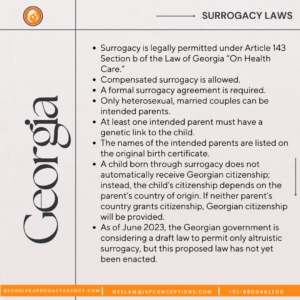
Yes, surrogacy is completely legal in Georgia. The country established one of the most progressive surrogacy legal frameworks in the world through specific legislation passed in 1997 and updated in subsequent years.
Legal Framework
Georgian law explicitly permits gestational surrogacy for married heterosexual couples. The legislation defines the rights and responsibilities of all parties involved in the surrogacy process. Intended parents gain full parental rights from conception, not just after birth.
The surrogate mother has no legal rights to the child. This legal position protects intended parents and provides certainty throughout the pregnancy. Surrogacy contracts are enforceable under Georgian law, offering additional security.
Commercial surrogacy in Georgia is legal and regulated. Surrogate mothers receive compensation for their time, effort, and the physical demands of pregnancy. This transparency ensures ethical treatment of all participants.
Surrogacy Laws in Georgia Government
The Georgian government oversees surrogacy through the Ministry of Health. Clinics must obtain proper licensing to offer IVF and surrogacy services. Regular inspections ensure compliance with medical and ethical standards.
Documentation requirements are clearly defined. The process includes medical evaluations, legal contracts, and official registrations. Government offices work efficiently to process paperwork for international intended parents.
Birth Certificate Rules
The birth certificate lists the intended parents as the legal mother and father. No mention of the surrogate mother appears on official documents. This simplifies citizenship and travel documents for the baby.
The registration process takes place at the Civil Registry Office in Tbilisi. Parents receive an official Georgian birth certificate shortly after delivery. This document serves as the foundation for obtaining passports and exit permits.
Some surrogacy-friendly countries like the USA embassy offer a passport for baby within 1-2 days for surrogacy baby birth in Georiga.
Have Questions About Surrogacy Laws in Georgia?
Get clarity on your parental rights, documentation requirements, and the registration process.
Who Can Do Surrogacy in Georgia?
Georgian surrogacy law specifies clear eligibility criteria for surrogacy. Understanding these requirements helps determine whether you qualify for surrogacy programs in the country.

Married Couples married for more than one year
Georgian law requires intended parents to be legally married. You must provide a marriage certificate as part of the application process. Common-law relationships or partnerships do not meet legal requirements.
Heterosexual Couples with a partnership have been together for more than one year
Current Georgian legislation limits surrogacy to heterosexual married couples. Single parents and same-sex couples cannot pursue surrogacy under existing laws. This restriction reflects the country’s current legal framework.
Medical Eligibility
Medical necessity forms the foundation of eligibility. Intended mothers must demonstrate a medical reason preventing them from carrying a pregnancy. Common qualifying conditions include absence of the uterus, severe uterine abnormalities, repeated IVF failures, or serious medical conditions making pregnancy dangerous.
Wondering if you qualify? Our team can evaluate your specific situation during a confidential consultation.
Why Choose Georgia for Gestational Surrogacy?
Multiple factors make Georgia an attractive destination for international surrogacy. The combination of legal certainty, medical expertise, and cost efficiency creates compelling advantages for intended parents.
#1. Affordable Surrogacy Cost in Georgia- Main Advantage
Surrogacy in Georgia costs significantly less than programs in Western countries. Complete packages range from $50,000 to $80,000, including medical procedures, surrogate compensation, and agency services. Comparable programs in the United States cost $120,000 to $200,000.
This average surrogacy expense difference does not reflect lower quality. Georgian clinics use the same medical protocols and technologies as leading international facilities. The lower cost stems from differences in living expenses and economic factors.
Georgia Surrogacy Costs
- Complete program: $50,000-$80,000
- IVF procedures included
- Surrogate compensation covered
- Legal services included
- Medical care throughout pregnancy
Western Countries Comparison
- USA programs: $120,000-$200,000
- UK altruistic only, long wait
- Canada is altruistic, with limited access
- Australia’s restrictive laws
- Most EU countries prohibit surrogacy
#2. Legal Clarity
Georgian surrogacy law provides certainty from start to finish. Intended parents become legal parents at conception. No adoption process or court proceedings are required after birth. This legal framework protects your rights throughout the journey.
Birth certificates list intended parents exclusively. The surrogate has no parental claims under law. This clear legal status simplifies citizenship and travel documentation for your baby.
Enforceable contracts protect all parties. Agreements specify obligations, compensation, and medical decisions. Georgian courts recognize and enforce these surrogacy contracts, providing security for everyone involved.
#3. Experienced Surrogacy Clinics in Tbilisi
Tbilisi hosts multiple fertility clinics with extensive international experience. These facilities have served thousands of foreign intended parents over more than two decades. Success rates at leading Georgian clinics compare favorably with top international centers.
Medical teams include internationally trained specialists. Doctors and embryologists bring expertise gained through education and practice in leading medical centers worldwide. English-speaking staff facilitate communication throughout your treatment.
IVF Clinics in Georgia offer comprehensive services beyond basic IVF. Services include genetic testing, egg donation programs, and specialized procedures for complex cases. This full spectrum of fertility treatments increases success rates for intended parents.
Surrogacy Process in Georgia (Step-by-Step)
Step 1: Consultation and Medical Evaluation
Your journey begins with an initial consultation. During this phase, you discuss your medical history, fertility challenges, and expectations with the surrogacy team. Medical professionals review your case to confirm eligibility.
You provide medical documentation supporting the need for surrogacy. This includes test results, physician letters, and relevant medical records. The clinic may request additional tests to complete your evaluation.
STEP 2: MATCHING WITH A SURROGATE MOTHER
The matching process connects you with a suitable surrogate mother. Agencies maintain databases of pre-screened, medically cleared surrogate candidates. You review profiles and select a surrogate who meets your preferences.
All surrogate mothers undergo rigorous screening. Medical evaluations confirm physical health and fertility. Psychological assessments ensure emotional readiness. Background checks verify personal circumstances and motivation.
Meeting your surrogate creates a personal connection. Many intended parents appreciate this opportunity, though some prefer to maintain privacy. The choice depends on your comfort level and preferences.
Legal contracts are prepared once matching is complete. These documents specify responsibilities, compensation, medical decisions, and communication expectations. Both parties sign agreements before medical procedures begin.
STEP 3: IVF AND EMBRYO TRANSFER
The IVF process creates embryos using sperm from the intended father and either eggs from the intended mother or an egg donor. The fertility clinic manages medication protocols and monitoring for both the egg source and the surrogate mother.
Egg retrieval takes place under sedation. The procedure collects mature eggs for fertilization. In the laboratory, specialists combine eggs and sperm to create embryos.
Embryos develop in the laboratory for three to five days. Specialists monitor growth and quality. Genetic testing may occur at this stage if requested, checking for chromosomal abnormalities or specific genetic conditions.
Embryo transfer involves placing one or two embryos into the surrogate’s uterus. This simple procedure takes only minutes. A pregnancy test occurs approximately two weeks later to confirm successful implantation.
Step 4: Pregnancy Management
The surrogate receives comprehensive prenatal care throughout the pregnancy. Regular medical check-ups monitor the baby’s development and the surrogate’s health. You receive updates at key milestones.
Ultrasound examinations occur at regular intervals. These scans check fetal growth and development. Many intended parents arrange to attend major ultrasounds, particularly the 20-week anatomy scan.
Communication with your surrogate continues based on agreed preferences. Some families maintain regular contact throughout pregnancy, while others prefer updates through coordinators. Both approaches work depending on personal comfort.
Step 5: Birth and Legal Exit
As delivery approaches, you travel to Georgia. Most intended parents arrive several weeks before the due date to ensure presence at birth. Your agency helps arrange accommodation near the delivery hospital.
Birth occurs in a modern Georgian hospital. You can be present during delivery based on hospital policies and your preferences. Medical teams provide excellent care for both the surrogate and the baby.
Legal procedures begin immediately after birth. The Civil Registry Office processes documentation to issue a birth certificate listing you as the legal parents. This typically completes within days of delivery.

Embassy procedures follow birth certificate issuance. You apply for a passport for your baby at your country’s embassy or consulate in Tbilisi. This process typically takes one to three weeks, depending on your nationality.
Exit permits from Georgian authorities confirm legal departure. With passport and proper documentation complete, you travel home with your baby. Your surrogacy journey concludes as you begin your new life as parents.
Ready to Start Your Surrogacy Journey in Georgia?
Get personalized support tailored to your unique situation.
Or email us at: neelam@ivfconceptions.com
Surrogacy Cost in Georgia
Surrogacy cost in Georgia is considered one of the most affordable and transparent options for international intended parents seeking a legally structured surrogacy journey. Compared to countries like the USA and parts of Europe, the cost of surrogacy in Georgia country is significantly lower while still including advanced medical care, experienced IVF clinics in Tbilisi, surrogate mother compensation, legal services, and full program management. A typical Georgia surrogacy program cost may vary depending on factors such as IVF cycles, egg donor requirements, guaranteed surrogacy packages, and medical complexities.
Despite the lower pricing, intended parents benefit from clear surrogacy laws in Georgia, high-quality fertility treatment, and a well-organized process, makingaffordable surrogacy in Georgia for foreigners a practical and trusted choice for building a family abroad.
The following table provides a comprehensive breakdown of surrogacy costs in Georgia. These figures represent typical ranges from established surrogacy programs serving international intended parents.
| Cost Component | Estimated Cost (USD) | What’s Included |
| Agency Coordination Fees | $8,000 – $12,000 | Case management, matching services, coordination throughout program, legal liaison |
| Medical Procedures (IVF) | $8,000 – $12,000 | IVF cycle, embryo creation, genetic testing (PGS/PGD), embryo transfer, pregnancy monitoring |
| Surrogate Mother Compensation | $25,000 – $28,000 | Base compensation, monthly allowance, maternity clothing, delivery compensation |
| Surrogate Medical Expenses | $3,000 – $5,000 | Prenatal care, medications, delivery costs, postnatal care, insurance coverage |
| Egg Donation (if needed) | $5,000 – $8,000 | Egg donor compensation, screening, stimulation medications, retrieval procedure |
| Legal Services | $3,000 – $5,000 | Contract preparation, birth certificate processing, embassy liaison, legal consultations |
| Travel and Accommodation | $4,000 – $8,000 | Flights to Georgia (2-3 trips), hotel accommodation, local transportation, meals |
| Contingency Reserve | $3,000 – $5,000 | Unexpected medical needs, additional legal fees, extended stay costs, emergency expenses |
| Total Estimated Cost | $50,000 – $80,000 | Complete surrogacy program from start to bringing baby home |
Cost of surrogacy in Georgia- Factors That May Vary
Several factors influence the final cost of your surrogacy program. Understanding these variables helps you budget accurately and avoid unexpected expenses.
- Number of IVF cycles needed – Success rates are high, but some cases require multiple embryo transfers
- Genetic testing requirements – PGS/PGD testing adds to costs but improves success rates
- Egg donation necessity – Using donor eggs increases costs but may be medically necessary
- Multiple pregnancy – Twins or triplets increase medical costs and surrogate compensation
- Travel frequency – Distance from your home country affects travel expenses
- Embassy processing time – Extended stays for passport processing increase accommodation costs
Get Detailed Surrogacy Expense in Georgia
Our transparent pricing ensures no hidden fees or surprises.
Timeline of Surrogacy in Georgia
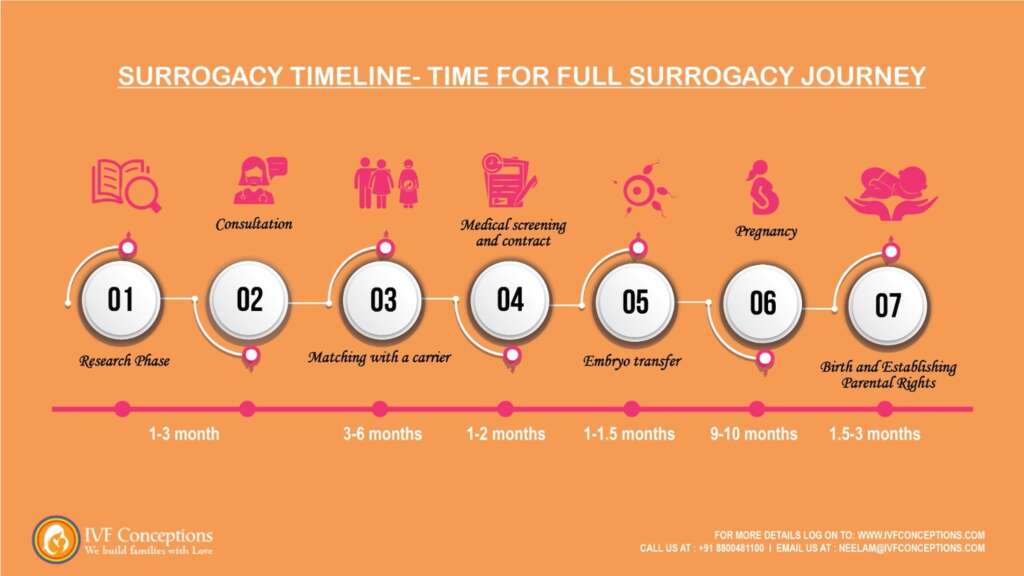
Understanding the surrogacy timeline helps intended parents plan their journey and set realistic expectations. The complete process typically spans 12 to 18 months from initial consultation to bringing your baby home.

Months 1-2: Initial Steps
The first phase involves consultation, evaluation, and matching. You complete medical screenings and provide necessary documentation. The agency begins searching for a suitable surrogate mother who meets your preferences.
Legal contracts are prepared during this phase. You review and sign agreements establishing the surrogacy arrangement. Financial arrangements are finalized, including payment schedules and cost details.
Months 2-3: Medical Preparation
IVF procedures begin once contracts are signed and surrogate matching is complete. The egg source (intended mother or donor) undergoes ovarian stimulation. The surrogate mother simultaneously prepares her uterus for embryo transfer through hormone medication.
Egg retrieval and fertilization create embryos. The laboratory culture these for three to five days. Embryo transfer occurs when both the embryos and the surrogate are ready.
Months 3-12: Pregnancy
Pregnancy confirmation occurs approximately two weeks after embryo transfer. The surrogacy program enters the pregnancy phase, lasting approximately nine months. Regular prenatal care monitors the baby’s development and surrogate’s health.
You receive updates throughout the pregnancy. Major milestones include first trimester completion, mid-pregnancy anatomy scan, and third trimester monitoring. Some intended parents visit Georgia for key appointments.

Communication with your surrogate continues based on your agreement. This connection helps many intended parents feel involved despite geographic distance.
Month 12: Birth and Initial Documentation
You travel to Georgia several weeks before the expected due date. Delivery occurs in a modern Georgian hospital with excellent medical care. Birth represents the culmination of your surrogacy journey.
Immediate legal procedures begin after delivery. The Civil Registry Office processes birth certificate applications. This documentation lists you as legal parents, establishing your baby’s legal status.
Months 12-13: Exit Procedures
Embassy procedures constitute the final timeline phase. You apply for a passport for your baby at your country’s embassy or consulate. Processing times vary by nationality but typically range from one to three weeks.
Georgian exit permits are obtained simultaneously. Once complete documentation is in hand, you travel home with your baby. The official timeline concludes, though your journey as parents has just begun.
Factors Affecting Timeline
Several variables may extend or shorten the standard timeline. Understanding these factors helps you plan appropriately.
- IVF success – First embryo transfer success shortens timeline; additional cycles extend it
- Medical complications – Any pregnancy complications require extended monitoring time
- Legal processing speed – Some embassies process passports faster than others
- Matching time – Finding the right surrogate match may take longer in some cases
- Travel constraints – Your availability for travel to Georgia affects scheduling
Most programs complete within the 12-18 month window. Planning for 15 months provides a realistic middle-ground estimate while allowing flexibility for variables.
Citizenship & Baby Exit Process
Citizenship and exit procedures represent critical final steps in your surrogacy journey. Understanding these processes ensures smooth completion and homecoming with your baby.

Birth Certificate Issuance
The birth certificate represents the foundational document for your baby’s legal identity. In Georgia, the Civil Registry Office issues birth certificates listing intended parents as legal mother and father. No mention of the surrogate mother appears on this document.
Application occurs within days of birth. Required documents include your passports, marriage certificate, and medical documentation from the hospital. The surrogacy agency coordinates this process, ensuring proper submission.
Processing typically completes within three to five business days. You receive an official Georgian birth certificate in both Georgian and English. This document serves as proof of parentage for all subsequent procedures.
Citizenship Options
Your baby’s citizenship depends on your home country’s laws. Most countries grant citizenship based on parentage, allowing your baby to acquire your nationality regardless of birthplace.
For United States citizens, babies born to American parents abroad automatically acquire U.S. citizenship. You apply for a Consular Report of Birth Abroad at the U.S. Embassy in Tbilisi. This document serves the same purpose as a U.S. birth certificate.
European Union countries typically grant citizenship based on parental nationality. Requirements vary by specific country. Most EU embassies in Tbilisi can process citizenship documentation and passports.
Australian and Canadian citizens follow similar parent-based citizenship rules. The baby acquires citizenship through the parent-child relationship. Embassy procedures formalize this citizenship status.
Passport Application Process
Obtaining a passport allows your baby to travel home legally. The process begins after receiving the Georgian birth certificate. You visit your country’s embassy or consulate in Tbilisi to submit passport applications.
Required documents typically include the Georgian birth certificate, proof of your citizenship, passport photos of the baby, and completed application forms. Embassy staff guide you through specific requirements for your nationality.

Processing times vary by embassy. United States passports typically take 10-14 days. European passports may process faster or slower depending on the specific country. Plan for approximately two weeks, though some cases complete sooner.
Expedited processing may be available for urgent situations. Discuss timing with embassy staff during your appointment. Most surrogacy agencies build adequate buffer time into program timelines.
Georgian Exit Permits
Georgian authorities require proper documentation for infants leaving the country. With your baby’s passport and birth certificate, obtaining exit permission is straightforward. The Civil Registry Office or relevant government department provides necessary clearances.
Your surrogacy agency coordinates this process. They ensure all documentation meets requirements for legal departure. This step typically completes quickly once passport issuance is finalized.
Travel Home
With complete documentation in hand, you can travel home with your baby. Airlines require proper identification for infant passengers. Your baby’s new passport serves this purpose.
Book flights in advance but maintain flexibility for documentation timing. Many parents purchase refundable tickets or book after receiving the passport. Travel with all original documents, including birth certificate and passport.
Some countries require additional entry documentation for newborns. Check your home country’s requirements before departure. Most countries readily admit citizens, even newborn citizens, with proper identification.
Additional Resources to Read:
Egg Donor Surrogacy in Georgia
International Surrogacy in Georgia (Country)
Surrogacy in Georgia for US Citizens
Surrogacy in Georgia vs Surrogacy in Armenia
Conclusion
Overall, surrogacy in Georgia country provides a balanced combination of legal clarity, medical expertise, and cost efficiency. Whether you need egg donor surrogacy in Georgia, IVF treatment, or a fully managed surrogacy program for foreigners, Georgia remains a trusted destination for international intended parents seeking a safe and structured surrogacy journey.
Begin Your Surrogacy Journey Today
Schedule your free consultation to discuss your unique situation and explore how surrogacy can help you build your family.
Prefer email? Contact Neelam at: neelam@ivfconceptions.com
Frequently Asked Questions About Surrogacy in Georgia

Is surrogacy in Georgia legal for foreigners?
Yes, surrogacy in Georgia is completely legal for international intended parents. The Georgian legal framework explicitly permits foreign couples to pursue gestational surrogacy. You must be a married heterosexual couple to qualify under current law. The legislation provides clear protections for intended parents’ rights from conception through birth and exit procedures.
How much does surrogacy cost in Georgia?
Complete surrogacy programs in Georgia typically cost between $50,000 and $70,000. This includes all medical procedures, surrogate compensation, legal services, and agency coordination. The exact cost depends on factors such as whether egg donation is needed, the number of IVF cycles required, and travel expenses specific to your situation. Georgian surrogacy costs approximately 50-60% less than comparable programs in the United States or other Western countries.
What is the success rate of IVF and surrogacy in Georgia?
Leading fertility clinics in Georgia report IVF success rates of 50-60% per embryo transfer for surrogacy programs. These rates align with international standards at top fertility centers worldwide. Success rates depend on factors including embryo quality, surrogate health, maternal age of the egg source, and whether genetic testing is performed. Multiple embryo transfer attempts increase overall program success rates significantly.
How long does the entire surrogacy process take?
The complete surrogacy journey in Georgia typically spans 12 to 18 months from initial consultation to bringing your baby home. This timeline includes matching with a surrogate (1-2 months), IVF procedures (1-2 months), pregnancy (9 months), and citizenship/exit procedures (2-4 weeks after birth). Individual circumstances may shorten or extend this timeframe depending on IVF success, medical factors, and embassy processing times.
Will my baby automatically get citizenship from my country?
Most countries grant citizenship to children based on parental citizenship regardless of birthplace. United States, UK, Australia, Canada, and most European nations follow this principle. Your baby acquires your nationality through the parent-child relationship. You process citizenship documentation at your embassy in Tbilisi after birth. Research your specific country’s requirements, as some nations have additional documentation steps for babies born through surrogacy abroad.
Can single parents or same-sex couples do surrogacy in Georgia?
No, current Georgian law limits surrogacy to married heterosexual couples only. Single parents and same-sex couples do not meet eligibility requirements under existing legislation. This legal restriction reflects Georgia’s current regulatory framework. Couples must provide a marriage certificate as part of the application process. Only opposite-sex married couples can pursue surrogacy in Georgia country at this time.
What rights does the surrogate mother have after birth?
The surrogate mother has no parental rights to the child under Georgian law. Legislation explicitly establishes that intended parents become legal parents from conception. The birth certificate lists only the intended parents, with no mention of the surrogate. Surrogacy contracts are legally enforceable in Georgia, further protecting intended parents’ rights. This clear legal framework provides certainty throughout the surrogacy process and after birth.
Do I need to travel to Georgia during the pregnancy?
Travel requirements vary based on personal preference and program structure. You must travel to Georgia for the embryo transfer procedure in most programs. You must also be present for birth and the subsequent citizenship/exit procedures. Some intended parents choose to visit for major ultrasounds or pregnancy milestones, though this is optional. Plan for at least two required trips: one for IVF procedures and one for birth and documentation.
What happens if the pregnancy is not successful?
Most comprehensive surrogacy programs include provisions for multiple embryo transfer attempts. If the first transfer does not result in pregnancy, additional frozen embryos can be transferred in subsequent cycles. Programs typically guarantee pregnancy rather than just a single attempt. Review specific guarantee terms with your agency during initial consultations. Additional attempts increase overall success likelihood while managing financial risk for intended parents.
Are Georgian medical standards comparable to Western countries?
Yes, leading fertility clinics in Georgia maintain medical standards equivalent to top international facilities. Clinics use modern IVF technology and follow international protocols. Many Georgian doctors and embryologists trained in Western Europe or the United States. Facilities undergo regular inspections and maintain appropriate certifications. Success rates at reputable Georgian clinics compare favorably with fertility centers in the US, UK, and other developed nations.
Can I meet the surrogate mother before starting?
Yes, most programs facilitate meetings between intended parents and potential surrogates during the matching phase. This meeting can occur in person if you travel to Georgia or via video call. Meeting your surrogate helps build connection and trust. However, some intended parents prefer to maintain more privacy throughout the process. Both approaches are acceptable. Discuss your preferences with your agency to structure the relationship in a way that feels comfortable for you.
What medical conditions qualify me for surrogacy in Georgia?
Medical necessity forms the basis for surrogacy eligibility. Qualifying conditions typically include absence of the uterus, severe uterine abnormalities, repeated IVF failures, or serious medical conditions making pregnancy dangerous. You need medical documentation from your physician explaining why surrogacy is medically recommended. Common situations include previous hysterectomy, congenital uterine abnormalities, severe heart conditions, or conditions threatening maternal health during pregnancy. Your case undergoes medical review during the initial consultation phase.
Still Have Questions?
Our experienced consultants provide personalized answers and guidance tailored to your circumstances.