

Planning surrogacy in Georgia country requires clear information, legal awareness, and realistic expectations. This comprehensive guide explains the complete surrogacy process in Georgia, including legal requirements, medical procedures, costs, timelines, egg donation options, IVF protocols, pregnancy monitoring, and exit procedures for foreign parents. Whether you are exploring international surrogacy in Georgia for married couples, researching Georgia surrogacy cost breakdown, or comparing destinations, this resource is designed to give you structured, practical insights before making a decision.
Georgia has become a recognized destination for gestational surrogacy programs in Europe, offering defined parentage laws and organized fertility clinics. However, every fertility journey is different. Medical suitability, embryo quality, legal eligibility, nationality rules, and personal circumstances all affect outcomes. There is no one-size-fits-all pathway.
This definitive guide is provided for informational purposes only. For medical evaluation, treatment protocols, or fertility planning, always consult a licensed fertility specialist. Laws, medical recommendations, and financial structures may change over time, and each case is unique.
If you would like guidance tailored to your personal situation, we encourage you to discuss your specific case with our subject matter experts in Georgia country to receive individualized clarity and next-step planning.
📞 Get in Touch for a Free Surrogacy Consultation
📱 +91-8800481100 (WhatsApp | LINE | Viber)
📧 neelam@ivfconceptions.com
🌐 www.georgiasurrogacyagency.com

Surrogacy in Georgia Country – Overview for Intended Parents
Georgia is one of the most established destinations for international surrogacy programs, especially for married heterosexual couples. With clear legislation, regulated IVF clinics, and structured birth registration procedures in Tbilisi, the country offers a defined legal pathway to parenthood.
Surrogacy in Georgia for foreigners is primarily gestational, meaning the surrogate has no genetic link to the baby. The legal framework allows intended parents to be listed directly on the birth certificate if eligibility requirements are fulfilled.
Below are key questions every intended parent should understand before starting the surrogacy process in Georgia.
Is surrogacy legal in Georgia for foreigners?
Yes, surrogacy in Georgia is legal for foreigners, provided they are legally married heterosexual couples. The law permits gestational surrogacy in Georgia, and the intended parents’ names are placed directly on the birth certificate.
Important legal aspects:
- Only gestational surrogacy programs in Georgia are allowed
- The surrogate has no parental rights after delivery
- Marriage certificate is mandatory
- Legal contract signed before embryo transfer
This legal clarity is one of the reasons Georgia remains a preferred destination for cross-border surrogacy arrangements.
If you wish to read more about Is surrogacy legal in Georgia for foreigners?, you can learn more in one of our blog.
Who can do surrogacy in Georgia?
Currently, who can do surrogacy in Georgia is clearly defined by law. Eligibility includes:
- Legally married heterosexual couples
- Couples with medical infertility documentation
- International intended parents meeting legal criteria
Surrogacy is not available for single individuals, unmarried couples, or same-sex couples under current regulations. Medical proof of infertility is typically required before proceeding with the IVF and surrogacy process in Georgia.
Understanding eligibility is essential before beginning the Georgia surrogacy program for foreigners.
If you wish to read more about Who can do surrogacy in Georgia?, you can learn more in one of our blog.
Why is Georgia in Europe popular for international surrogacy?
Georgia has become well known for affordable surrogacy in Europe, especially compared to destinations like the United States.
Reasons for popularity include:
-
- Clear and established surrogacy laws in Georgia
- Direct birth certificate issuance
- Competitive overall surrogacy cost in Georgia
- Experienced IVF clinics in Tbilisi
- Structured surrogate screening
The combination of legal clarity and moderate pricing makes it attractive for couples seeking legal surrogacy in Europe for foreigners.
If you wish to read more about Why is Georgia in Europe popular for international surrogacy?, you can learn more in one of our blogs.
Is Georgia a safe country for surrogacy?
Many intended parents ask, is Georgia safe for surrogacy? Tbilisi hosts regulated fertility centers that follow structured IVF protocols and legal contracts.
Safety factors include:
- Formal surrogacy agreements
- Government-recognized birth registration
- Medical and psychological screening of surrogates
- Embassy exit support after birth
Choosing experienced professionals ensures compliance with both Georgian regulations and home-country citizenship processes.
If you wish to read more about Is Georgia a safe country for surrogacy?, you can learn more in one of our blog.
How long does surrogacy in Georgia take? Surrogacy Timeline in Georgia Tbilisi?
The surrogacy timeline in Georgia Tbilisi typically ranges from 12 to 18 months, depending on embryo availability and surrogate matching speed.
General timeline overview:
- Consultation and legal documentation (1–2 months)
- Surrogate matching (1–3 months)
- IVF cycle and embryo transfer
- Pregnancy period (9 months)
- Birth certificate and baby exit process (2–6 weeks)
If embryos are already created, the Georgia surrogacy timeline for foreigners may be shorter.
If you wish to read more about How long does surrogacy in Georgia take?, you can learn more in one of our blog.
What are the success rates of surrogacy in Georgia?
Surrogacy success rates in Georgia depend largely on embryo quality, egg source, and clinic expertise.
Clinics often report:
- 55%–70% pregnancy rate per embryo transfer (with donor eggs)
- Higher outcomes with PGT-tested embryos
- Improved results when the egg donor is under 30 years old
Success varies individually and should be evaluated through medical consultation before starting the IVF surrogacy program in Georgia.
If you wish to read more about What are the success rates of surrogacy in Georgia?, you can learn more in one of our blog.
📞 Get in Touch for a Free Surrogacy Consultation
📱 +91-8800481100 (WhatsApp | LINE | Viber)
📧 neelam@ivfconceptions.com
🌐 www.georgiasurrogacyagency.com
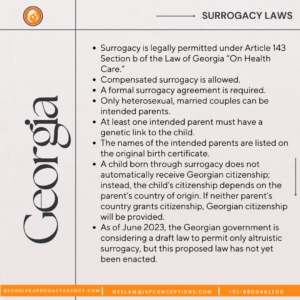
Surrogacy Laws in Georgia Tiblisi
Georgia has one of the most clearly defined legal frameworks for gestational surrogacy in Europe. The law regulates eligibility, birth registration, and parental recognition, making surrogacy laws in Georgia Tbilisi an important consideration for international intended parents.
Understanding the legal structure is essential before starting a legal surrogacy program in Georgia, especially for foreigners.
What does Georgia law say about surrogacy?
Under Georgian legislation, gestational surrogacy is legally permitted for married heterosexual couples with medical infertility. The intended parents are recognized as the legal parents from birth, provided all contractual and medical requirements are fulfilled.
Key legal principles include:
- Surrogacy must be gestational (no genetic link to surrogate)
- Legal contract signed before embryo transfer
- Intended parents registered on birth certificate
- Marriage certificate required
The law provides legal clarity, which is why Georgia surrogacy law for foreigners is often considered structured and predictable.
If you wish to read more about What does Georgia law say about surrogacy?, you can learn more in one of our blog.
IS SURROGACY LEGAL IN GEORIGA COUNTRY?
Yes, surrogacy is legal in Georgia country under national legislation. It has been legally recognized since 1997, making Georgia one of the earlier countries to regulate commercial gestational surrogacy.
However, legality applies only to eligible married heterosexual couples with documented infertility. Single individuals and same-sex couples are not currently permitted under the law.
The legal stability makes legal surrogacy in Georgia for foreigners attractive compared to countries where surrogacy is banned or unclear.
If you wish to read more about Is surrogacy legal in Georgia country?, you can learn more in one of our blog.
Are intended parents listed directly on the birth certificate in Georgia?
Yes, in approved cases, intended parents are listed directly on the Georgian birth certificate. There is no requirement for post-birth adoption if eligibility conditions are satisfied.
This is one of the strongest advantages of Georgia surrogacy birth certificate process, as the surrogate’s name does not appear as the legal mother.
Direct registration simplifies embassy procedures and newborn passport applications for international parents.
If you wish to read more about Are intended parents listed directly on the birth certificate in Georgia?, you can learn more in one of our blog.
Does the surrogate have parental rights in Georgia?
Under Georgian law, the surrogate does not retain parental rights after birth in a properly structured gestational surrogacy agreement in Georgia.
Once the child is born, the intended parents are legally recognized as mother and father, provided all documentation is compliant.
This legal clarity reduces the risk of parental disputes and provides confidence to international intended parents choosing secure surrogacy programs in Georgia.
If you wish to read more about Does the surrogate have parental rights in Georgia?, you can learn more in one of our blog.
IS A COURT ORDER REQUIRED FOR SURROGACY IN GEORGIA?
No, in most eligible cases, a court order is not required for surrogacy in Georgia. The civil registry directly issues the birth certificate naming the intended parents.
This differs from countries where pre-birth or post-birth court approvals are mandatory.
The absence of a court process makes the Georgia surrogacy legal process faster and more predictable for foreign couples.
If you wish to read more about Is a court order required for surrogacy in Georgia?, you can learn more in one of our blogs.
Can single parents do surrogacy in Georgia?
Currently, single parents cannot legally do surrogacy in Georgia under existing legislation. The law restricts eligibility to legally married heterosexual couples with infertility documentation.
Single intended parents must explore alternative countries where single parent surrogacy abroad is legally permitted.
Understanding this limitation is critical before starting a Georgia surrogacy program.
If you wish to read more about Can single parents do surrogacy in Georgia?, you can learn more in one of our blogs.
Can same-sex couples do surrogacy in Georgia?
Under current regulations, same-sex couples are not eligible for surrogacy in Georgia. The legal framework restricts access to married heterosexual couples.
Couples seeking LGBT surrogacy in Europe may need to consider alternative jurisdictions where laws are more inclusive.
Legal eligibility should always be verified before signing any contract.
If you wish to read more about Can same-sex couples do surrogacy in Georgia?, you can learn more in one of our blog.
How is citizenship handled after surrogacy in Georgia?
After birth, the baby receives a Georgian birth certificate listing the intended parents. Citizenship depends on the parents’ nationality and embassy procedures.
The Georgia surrogacy citizenship process typically involves:
- Obtaining birth certificate
- Applying for passport or travel document
- Completing embassy DNA testing (if required)
- Securing exit clearance
The timeline varies depending on the parents’ home country regulations.
If you wish to read more about How is citizenship handled after surrogacy in Georgia?, you can learn more in one of our blog.
What legal documents are required to start the legal surrogacy in Georgia?
To begin a legal surrogacy process in Georgia, intended parents typically need:
- Valid marriage certificate
- Passports
- Medical infertility documentation
- Notarized surrogacy agreement
- IVF clinic documentation
Proper preparation ensures smooth embryo transfer and later birth registration.
If you wish to read more about What legal documents are required to start the legal surrogacy in Georgia?, you can learn more in one of our blog.
Can foreigners do surrogacy in Georiga country?
Yes, foreigners can do surrogacy in Georgia country, provided they meet legal eligibility criteria. Many international couples choose Georgia due to its established legal framework and structured birth certificate process.
However, foreign parents must also consider embassy procedures, citizenship laws, and newborn passport timelines.
Working with experienced professionals helps ensure compliance with both Georgian law and home-country regulations.
If you wish to read more about Can foreigners do surrogacy in Georgia country?, you can learn more in one of our blog.
📞 Get in Touch for a Free Surrogacy Consultation
📱 +91-8800481100 (WhatsApp | LINE | Viber)
📧 neelam@ivfconceptions.com
🌐 www.georgiasurrogacyagency.com

SURROGACY PROCESS IN GEORGIA – STEP BY STEP
The surrogacy process in Georgia is structured, legally regulated, and medically supervised from start to finish. Most programs are managed through licensed IVF clinics in Tbilisi, operating under the legal framework of Georgia.
Understanding the step-by-step surrogacy process in Georgia helps intended parents plan timelines, budgets, and travel arrangements more effectively.
What is the step-by-step surrogacy process in Georgia?
The step-by-step surrogacy process in Georgia typically follows a clear structure:
- Initial consultation and medical evaluation
- Legal documentation and contract signing
- Surrogate matching
- IVF cycle and embryo transfer
- Pregnancy monitoring
- Delivery and birth registration
- Citizenship and exit procedures
If embryos are already available, the process may move faster. Proper documentation before embryo transfer is essential for smooth birth registration.
If you wish to read more about What is the step-by-step surrogacy process in Georgia?, you can learn more in one of our blog.
HOW ARE SURROGATES SELECTED IN GEORGIA? WHO CAN BE SURROGATE IN GEORIGA COUNTY?
Surrogate selection in Georgia follows medical and legal criteria. A woman must:
- Be between approximately 21–35 years old
- Have at least one healthy child
- Pass medical and psychological screening
- Have no major pregnancy complications history
Surrogates must meet health standards before acceptance into a Georgia surrogacy program. Matching is based on medical compatibility and availability.
This structured selection process increases the safety and reliability of gestational surrogacy in Georgia.
If you wish to read more about How are surrogates selected in Georgia?, you can learn more in one of our blog.
What medical screening is done before starting?
Before beginning the Georgia surrogacy IVF process, both intended parents and the surrogate undergo medical screening.
Common tests include:
- Infectious disease screening
- Hormonal evaluations
- Uterine health assessment
- Semen analysis (if using own sperm)
- Genetic testing (if required)
These evaluations ensure readiness for embryo transfer and reduce medical risks during pregnancy. Clinics follow structured reproductive medicine protocols.
If you wish to read more about What medical screening is done before starting?, you can learn more in one of our blog.
HOW DOES IVF WORK IN GEORGIA SURROGACY PROGRAMS?
In IVF surrogacy programs in Georgia, embryos are created using the intended parents’ gametes or donor eggs/sperm. The embryo is then transferred into the surrogate’s uterus.
Steps include:
-
- Ovarian stimulation (if using intended mother or donor eggs)
- Egg retrieval and fertilization
- Embryo culture (3–5 days)
- Optional PGT-A genetic testing
- Embryo transfer to surrogate
Since it is gestational surrogacy in Georgia, the surrogate has no genetic link to the baby.
If you wish to read more about How does IVF work in Georgia surrogacy programs?, you can learn more in one of our blog.
HOW MANY EMBRYO TRANSFERS ARE USUALLY INCLUDED?
Most surrogacy programs in Georgia include one to three embryo transfers, depending on the clinic and agreement.
The number of transfers may depend on:
- Embryo availability
- Age of egg provider
- Embryo quality
- Contract terms
Some programs offer package structures that include multiple transfers within a fixed cost model. Clear understanding of transfer limits is important before signing a Georgia surrogacy contract.
If you wish to read more about How many embryo transfers are usually included?, you can learn more in one of our blog.
What happens during pregnancy monitoring in Georgia?
During pregnancy, the surrogate undergoes regular medical monitoring in Tbilisi clinics.
Pregnancy monitoring includes:
- Routine ultrasounds
- Blood tests
- Obstetric consultations
- High-risk monitoring if needed
Intended parents typically receive medical updates and scan reports. Proper monitoring ensures safety throughout the surrogacy pregnancy in Georgia.
If you wish to read more about What happens during pregnancy monitoring in Georgia?, you can learn more in one of our blog.
WHAT HAPPENS AFTER THE BABY IS BORN IN GEORGIA?
After delivery, the hospital issues medical confirmation documents required for civil registration.
The process includes:
- Birth certificate issuance listing intended parents
- Passport application for the newborn
- Embassy documentation
- DNA testing (if required by embassy)
The Georgia surrogacy birth process is generally straightforward when eligibility requirements are fulfilled in advance.
If you wish to read more about What happens after the baby is born in Georgia?, you can learn more in one of our blog.
HOW LONG DO PARENTS NEED TO STAY IN GEORGIA AFTER BIRTH?
Most international parents stay in Georgia for approximately 2 to 6 weeks after birth, depending on embassy processing timelines.
The duration depends on:
- Home country citizenship laws
- DNA testing requirements
- Passport issuance speed
- Exit clearance procedures
Planning travel flexibility is essential when undergoing international surrogacy in Georgia.
If you wish to read more about How long do parents need to stay in Georgia after birth?, you can learn more in one of our blog.
📞 Get in Touch for a Free Surrogacy Consultation
📱 +91-8800481100 (WhatsApp | LINE | Viber)
📧 neelam@ivfconceptions.com
🌐 www.georgiasurrogacyagency.com

COST OF SURROGACY IN GEORGIA
Understanding the cost of surrogacy in Georgia is crucial for planning your journey. Prices vary based on services included, clinic standards, and medical needs like donor eggs or genetic testing. Generally, Georgia offers competitive surrogacy pricing compared to the USA and some European countries, making it a popular choice for international intended parents.
How much does Average surrogacy cost in Georgia with breakdown?
The average surrogacy cost in Georgia typically ranges between €45,000 – €70,000 (approx.), depending on clinic and package inclusions. A typical breakdown may include:
- IVF and embryo transfer: €8,000–€12,000
- Surrogate compensation: €12,000–€18,000
- Legal fees: €4,000–€6,000
- Medical monitoring & maternity care: €7,000–€10,000
- Administrative and coordination: €3,000–€6,000
- Embryo storage, travel, and miscellaneous: €2,000–€4,000
Final pricing depends on medical needs and package choice.
If you wish to read more about How much does average surrogacy cost in Georgia, you can learn more in one of our blog.
WHAT IS INCLUDED IN A GEORGIA SURROGACY PACKAGE?
A Georgia surrogacy package generally includes:
- Surrogate matching and screening
- Medical tests for surrogate and intended parents
- IVF cycle & embryo transfer
- Pregnancy monitoring
- Legal contracts and documentation
- Birth certificate processing
- Coordination & case management
Some packages also cover travel support, airport transfers, and embryo storage. Additional services like egg donation or PGT testing are often extra.
If you wish to read more about What is included in a Georgia surrogacy package?, you can learn more in one of our blog.
ARE THERE HIDDEN COSTS IN GEORGIA SURROGACY PROGRAMS?
While Georgia is known for transparent pricing, some hidden costs in Georgia surrogacy programs may arise:
- Embassy DNA testing fees
- Newborn passport & visa fees
- Extra medical tests not initially planned
- Travel and accommodation
- Additional embryo transfer cycles
Careful contract review helps avoid unexpected expenses.
If you wish to read more about Are there hidden costs in Georgia surrogacy programs?, you can learn more in one of our blog.
HOW MUCH DOES IVF COST IN GEORGIA?
The IVF cost in Georgia typically ranges from €7,000 to €15,000 per cycle, depending on clinic reputation and services included. This generally covers:
- Ovarian stimulation & monitoring
- Egg retrieval
- Fertilization
- Embryo culture
- First embryo transfer
Optional services like PGT-A genetic testing or advanced embryo storage may cost extra.
If you wish to read more about How much does IVF cost in Georgia?, you can learn more in one of our blog.
HOW MUCH IS SURROGATE COMPENSATION IN GEORGIA?
Surrogate compensation in Georgia varies based on agreement terms and experience. On average, surrogate mothers receive €12,000–€18,000 for participation, which is separate from medical and administrative costs.
This compensation supports the surrogate through pregnancy and post-delivery recovery.
If you wish to read more about How much is surrogate compensation in Georgia?, you can learn more in one of our blog.
WHAT IS THE COST OF EGG DONATION IN GEORGIA?
The cost of egg donation in Georgia typically ranges between €4,000–€7,000, depending on donor criteria and clinic policies. It includes donor screening, stimulation, and egg retrieval.
Factors like donor age and genetic testing may influence final pricing.
If you wish to read more about What is the cost of egg donation in Georgia?, you can learn more in one of our blog.
WHAT IS COST OF IVF EGG DONOR IN GEORGIA?
The cost of IVF with egg donor in Georgia combines:
- Egg donation fees (€4,000–€7,000)
- IVF cycle & embryo transfer (€7,000–€15,000)
Total IVF egg donor cost in Georgia generally ranges from €12,000 to €22,000. Additional testing like PGT-A may add to the total.
If you wish to read more about What is cost of IVF egg donor in Georgia?, you can learn more in one of our blog.
WHAT HAPPENS FINANCIALLY IF THE FIRST TRANSFER FAILS?
If the first embryo transfer fails, costs depend on your contract:
- Some packages include multiple embryo transfers
- Others charge per additional transfer (€1,000–€3,000 each)
- Extra medical monitoring or medications may also apply
Knowing transfer policies upfront avoids surprises.
If you wish to read more about What happens financially if the first transfer fails?, you can learn more in one of our blog.
WHAT IS SURROGATE MOTHER COST IN GEORIGA COUNTRY?
The surrogate mother cost in Georgia country typically includes the agreed compensation (€12,000–€18,000) plus any medical or maternity-related expenses not covered by the clinic package.
All financial terms should be clearly outlined in the surrogacy contract.
If you wish to read more about What is surrogate mother cost in Georgia country?, you can learn more in one of our blogs.
CAN WE OPT FOR GUARANTEE BABY SURROGACY PROGRAM IN GEORIGA?
Many clinics in Georgia offer guaranteed baby surrogacy programs, which ensure multiple transfer attempts until a successful pregnancy is achieved. These packages often come with higher upfront costs but reduce the risk of additional charges later.
Guarantee programs vary by clinic, so clear terms are essential.
If you wish to read more about Can we opt for guarantee baby surrogacy program in Georgia?, you can learn more in one of our blogs.
What is guarantee baby surrogacy cost in Georiga, Europe?
The guaranteed baby surrogacy cost in Georgia usually ranges from €70,000–€90,000+, depending on the number of transfers included, donor use, and additional medical needs.
These packages often include:
- Multiple embryo transfers
- Surrogate compensation
- Legal and IVF services
- Pregnancy monitoring
This model provides financial predictability and higher peace of mind for intended parents.
If you wish to read more about What is guarantee baby surrogacy cost in Georgia, Europe?, you can learn more in one of our blog.
📞 Get in Touch for a Free Surrogacy Consultation
📱 +91-8800481100 (WhatsApp | LINE | Viber)
📧 neelam@ivfconceptions.com
🌐 www.georgiasurrogacyagency.com

EGG DONATION AND IVF IN GEORGIA
The combination of egg donation and IVF in Georgia is often chosen by international intended parents seeking higher success rates, especially when the intended mother cannot use her own eggs. Georgia has established reproductive clinics in Tbilisi that offer structured donor programs, donor screening, and advanced IVF services. Understanding how egg donation works in Georgia and the associated IVF standards helps intended parents make informed decisions about their fertility journeys.
IS EGG DONATION ANONYMOUS IN GEORGIA?
In most cases, egg donation in Georgia is anonymous, meaning the identity of the donor is not disclosed to the intended parents or the child. Clinics follow privacy protocols to protect donor confidentiality. However, some programs may allow non-anonymous donation based on agreement specifics and legal consent.
This anonymity allows intended parents to proceed without direct contact with the donor while ensuring legal clarity for surrogacy and IVF procedures in Georgia.
If you wish to read more about Is egg donation anonymous in Georgia?, you can learn more in one of our blog.
HOW ARE EGG DONORS SCREENED IN GEORGIA?
Egg donors in Georgia are carefully screened to ensure medical suitability and lower genetic risks. Screening typically includes:
- Comprehensive health and medical history evaluation
- Infectious disease testing
- Hormonal assessments
- Genetic carrier screening
- Psychological evaluation
The screening ensures that only healthy donors participate in the egg donation and IVF process in Georgia, increasing the chances of successful fertilization and pregnancy.
If you wish to read more about How are egg donors screened in Georgia?, you can learn more in one of our blog.
CAN INTENDED PARENTS CHOOSE DONOR ETHNICITY IN GEORGIA?
Yes, in many Georgian clinics, intended parents can choose donor ethnicity or physical characteristics within the available donor pool. Options vary by clinic and donor availability. Intended parents often select based on preferences for:
- Ethnicity
- Hair/eye color
- Height
- Educational background
Choosing donor traits may help intended parents feel more connected to their future child during the egg donation and surrogacy process in Georgia.
If you wish to read more about Can intended parents choose donor ethnicity in Georgia?, you can learn more in one of our blog.
WHAT IS THE DIFFERENCE BETWEEN FRESH AND FROZEN DONORS IN GEORGIA?
The difference between fresh and frozen donors in Georgia lies in how the eggs are prepared and available for IVF:
- Fresh donors – Donor undergoes ovarian stimulation, eggs are retrieved and used in the same cycle.
- Frozen donors – Eggs are retrieved, frozen, and stored for future use.
Frozen donor programs provide flexibility in timing but may have slightly different success rates compared to fresh cycles. Both types are available in Georgia, and selection depends on family preference and clinic protocols.
If you wish to read more about What is the difference between fresh and frozen donors in Georgia?, you can learn more in one of our blog.
CAN YOU SHIP FROZEN EMBRYOS TO GEORGIA?
Yes, intended parents can generally ship frozen embryos to Georgia for use in surrogacy programs, provided proper legal and medical documentation accompanies the embryos. Transport requires:
- Compliance with international transport regulations
- Coordination with airlines and courier services
- Necessary paperwork for customs and clinic acceptance
Using frozen embryos allows parents to begin the Georgia IVF and surrogacy process without creating new embryos locally.
If you wish to read more about Can you ship frozen embryos to Georgia?, you can learn more in one of our blog.
WHAT ARE THE IVF SUCCESS RATES IN GEORGIA IVF CLINICS?
IVF success rates in Georgia IVF clinics depend on multiple factors, including:
- Age and health of egg provider (own or donor)
- Embryo quality
- Use of genetic testing (e.g., PGT-A)
- Clinic expertise
With donor eggs, many clinics report pregnancy rates per transfer often between 55%–70% or higher. Success varies individually and should be reviewed with the clinic before starting. Higher success is often seen when using eggs from younger, healthy donors.
If you wish to read more about What are IVF success rates in Georgia IVF clinics?, you can learn more in one of our blog.

SAFETY, TRAVEL, AND LIVING IN GEORGIA
When planning international surrogacy in Georgia, intended parents must consider safety, travel logistics, accommodation, and living expenses. Georgia has become a well-known destination for medical tourism, especially in Tbilisi, where most IVF and surrogacy clinics are located.
Understanding travel safety in Georgia, the cost of living, and stay duration helps parents prepare financially and emotionally for their surrogacy journey.
IS IT SAFE TO TRAVEL TO GEORGIA FOR SURROGACY?
Yes, Georgia is generally considered safe for international visitors, including those traveling for medical tourism and surrogacy programs. Tbilisi, in particular, has a strong presence of international clinics, private hospitals, and expat-friendly services.
Safety advantages include:
- Stable healthcare infrastructure
- Regulated fertility clinics
- English-speaking coordinators in major centers
- Established medical tourism network
As with any international travel, parents should monitor travel advisories and maintain travel insurance during their surrogacy journey in Georgia.
Read more: Is it safe to travel to Georgia for surrogacy?
IS TBILISI SAFE FOR INTERNATIONAL PARENTS?
Tbilisi is considered one of the safest cities in the region for foreigners. Many international intended parents stay there for several weeks during birth and documentation procedures.
Safety factors include:
- Low violent crime rates in central areas
- Modern private hospitals
- International hotels and serviced apartments
- Reliable transportation services
Most fertility clinics are located in secure and accessible neighborhoods, making Tbilisi surrogacy stay comfortable for international parents.
Read more: Is Tbilisi safe for international parents?
HOW LONG DO PARENTS NEED TO STAY IN GEORGIA?
For most surrogacy cases in Georgia, intended parents typically stay between 2 to 6 weeks after birth.
The duration depends on:
- Birth certificate issuance
- Embassy DNA testing (if required)
- Newborn passport processing
- Exit clearance timeline
Planning flexible travel dates is important, as Georgia surrogacy exit procedures vary depending on the parents’ home country’s citizenship laws.
Read more: How long do parents need to stay in Georgia?
WHERE DO INTENDED PARENTS STAY IN TBILISI?
Intended parents usually choose:
- Serviced apartments
- Short-term rental flats
- International hotel chains
- Airbnb-style accommodations
Many parents prefer apartments near fertility clinics or central Tbilisi for convenience. Staying in family-friendly areas helps during the newborn care period while completing paperwork.
Accommodation selection often depends on budget and the expected post-birth stay duration in Georgia.
Read more: Where do intended parents stay in Tbilisi?
WHAT IS THE COST OF LIVING IN GEORGIA DURING SURROGACY?
The cost of living in Georgia during surrogacy is generally moderate compared to Western Europe or the United States. Estimated monthly expenses may include:
- Accommodation: €800–€1,800 (depending on property type)
- Food and groceries: €300–€600
- Transportation: €100–€200
- Miscellaneous expenses: €200–€400
Actual expenses vary based on lifestyle, length of stay, and location within Tbilisi. Budget planning should account for both medical and living costs during the Georgia surrogacy process.
Read more: What is the cost of living in Georgia during surrogacy?
📞 Get in Touch for a Free Surrogacy Consultation
📱 +91-8800481100 (WhatsApp | LINE | Viber)
📧 neelam@ivfconceptions.com
🌐 www.georgiasurrogacyagency.com

RISKS AND THINGS TO CONSIDER BEFORE CHOOSING GEORGIA
Before starting surrogacy in Georgia, intended parents should carefully evaluate legal stability, medical risks, and exit procedures. While Georgia offers a structured framework for gestational surrogacy programs, every international arrangement carries medical, legal, and logistical considerations.
Understanding potential risks in advance helps parents plan responsibly and choose a well-managed Georgia surrogacy program for foreigners.
WHAT ARE THE RISKS OF DOING SURROGACY IN GEORGIA?
Like any international fertility journey, risks of doing surrogacy in Georgia may include:
- Legal eligibility restrictions
- Policy changes affecting future applicants
- IVF cycle failure
- Pregnancy complications
- Embassy or citizenship delays
Although Georgia has historically maintained legal clarity, intended parents must work with experienced professionals to minimize risks related to documentation and compliance.
Careful contract review and realistic medical expectations are essential when pursuing international surrogacy in Georgia.
Read more: What are the risks of doing surrogacy in Georgia?
ARE GEORGIA SURROGACY LAWS CHANGING?
There have been discussions in recent years regarding potential updates to surrogacy laws in Georgia, particularly concerning eligibility for foreigners. Legal frameworks can evolve based on government policy decisions.
While surrogacy remains legally permitted under current legislation, intended parents should verify the most recent regulations before beginning the process. Monitoring updates related to Georgia surrogacy law changes is crucial for planning timelines.
Legal clarity at the time of contract signing is especially important.
Read more: Are Georgia surrogacy laws changing?
What happens if laws change during the process?
If legal changes occur during an ongoing Georgia surrogacy program, outcomes typically depend on transitional provisions in the updated law. In many jurisdictions, existing contracts signed under valid regulations are often protected, but this cannot be guaranteed without legal review.
This is why early documentation, properly executed contracts, and clinic registration are essential before embryo transfer.
Intended parents should always seek updated legal guidance to reduce uncertainty in case of policy changes in Georgian surrogacy law.
Read more: What happens if laws change during the process?
WHAT HAPPENS IF THERE ARE PREGNANCY COMPLICATIONS?
In case of pregnancy complications during surrogacy in Georgia, the surrogate receives care at licensed obstetric hospitals in Tbilisi.
Possible scenarios include:
- Preterm labor
- Gestational diabetes
- High-risk pregnancy monitoring
- Emergency C-section
Medical insurance coverage and contractual clauses usually define financial responsibilities in such cases. Proper monitoring through structured pregnancy management in Georgia surrogacy programs helps reduce medical risks.
Read more: What happens if there are pregnancy complications?
WHAT HAPPENS IN CASE OF TWIN PREGNANCIES?
Twin pregnancies can occur if more than one embryo is transferred. In such cases, pregnancy is monitored more closely due to increased medical risk.
Considerations include:
- Higher medical monitoring costs
- Increased risk of preterm birth
- Neonatal care expenses if early delivery occurs
Contracts should clearly define policies regarding multiple embryo transfer in Georgia surrogacy programs, including financial responsibilities for twin births.
Read more: What happens in case of twin pregnancies?
What are the exit process challenges for foreign parents?
One of the most important considerations in international surrogacy in Georgia is the exit process. Challenges may include:
- Embassy DNA testing requirements
- Delays in newborn passport issuance
- Citizenship eligibility rules in the parents’ home country
- Additional legal documentation requests
The Georgia surrogacy exit process for foreigners depends largely on the nationality of the intended parents. Planning for a 2–6 week stay after birth is common, but timelines can vary.
Read more: What are the exit process challenges for foreign parents?
📞 Get in Touch for a Free Surrogacy Consultation
📱 +91-8800481100 (WhatsApp | LINE | Viber)
📧 neelam@ivfconceptions.com
🌐 www.georgiasurrogacyagency.com

COMPARING GEORGIA WITH OTHER SURROGACY COUNTRIES
When planning international surrogacy, comparing destinations helps intended parents decide which option best fits their legal, medical, budget, and personal needs. Georgia is often compared with the United States, Colombia, and Ukraine. Each destination has unique surrogacy advantages and limitations, so understanding differences in law, cost, safety, and support structures is essential for informed decision-making.
GEORGIA COUNTRY VS USA FOR SURROGACY – WHICH IS BETTER?
Georgia vs USA for surrogacy varies depending on priorities:
- Legal clarity: Both offer legal frameworks, but Georgia lists parents directly on birth certificates without post-birth adoption in eligible cases.
- Cost: Georgia is significantly more affordable.
- Clinic infrastructure: USA clinics may offer higher-end facilities, but Georgia clinics are experienced in gestational surrogacy for foreigners.
- Travel: Georgia offers shorter stays after birth compared to many U.S. states.
Intended parents seeking lower overall cost often prefer Georgia, while those prioritizing the broadest legal environment (e.g., LGBTQ+ inclusivity) may lean toward the USA.
Read more: Georgia Country vs USA for surrogacy – which is better?
GEORGIA VS COLOMBIA FOR SURROGACY
Georgia vs Colombia for surrogacy comparisons include:
- Legal framework: Georgia’s law clearly defines parental rights; Colombia’s laws have historically been less structured and more variable.
- Cost: Both are cost-effective compared to U.S. or European options, but Georgia’s pricing is typically more predictable.
- Documentation: Georgia offers relatively smoother birth registration procedures.
For parents seeking structured legal certainty and moderate cost, Georgia is often preferred.
Read more: Georgia vs Colombia for surrogacy
GEORGIA VS UKRAINE FOR SURROGACY
Georgia vs Ukraine for surrogacy involves legal and geopolitical considerations:
- Legal recognition: Both countries permit gestational surrogacy, but Georgia’s law provides clearer birth registration in parents’ names.
- Safety & stability: Georgia is politically stable; Ukraine has faced geopolitical challenges that have affected medical services at times.
- Cost: Ukraine may have slightly lower base costs, but availability and full service consistency vary.
Many international couples prioritize Georgia for clearer legal structure and fewer travel disruptions.
Read more: Georgia vs Ukraine for surrogacy
IS GEORGIA CHEAPER THAN OTHER COUNTRIES?
Yes, Georgia is generally cheaper than many other surrogacy destinations, especially the USA, Canada, and much of Western Europe. Although some Latin American and Asian countries may offer lower base prices, Georgia balances cost with legal clarity, birth certificate certainty, and structured medical protocols.
Budget-minded intended parents often choose Georgia for cost-effective surrogacy abroad without sacrificing legal certainty.
Read more: Is Georgia cheaper than other countries?
WHICH COUNTRY IS SAFEST FOR INTERNATIONAL SURROGACY?
Safety in international surrogacy encompasses:
- Legal certainty
- Healthcare standards
- Political stability
- Travel safety
Countries like Canada, the USA, and Georgia score high in legal and medical safety. Georgia offers regulated clinics and clear birth certification in eligible cases, making it a dependable choice for families seeking surrogacy abroad with legal protection.
Read more: Which country is safest for international surrogacy?
WHICH COUNTRY IS CHEAPEST FOR INTERNATIONAL SURROGACY?
The cheapest country for international surrogacy depends on packages, medical needs, and legal requirements. Destinations often mentioned for lower costs include:
- Georgia
- Some Latin American countries
- Certain clinics in Eastern Europe or Asia
However, “cheapest” should be balanced with legal certainty, healthcare quality, and exit procedures to avoid unexpected costs. Georgia’s combination of affordability and legal clarity often makes it one of the most cost-effective choices overall.
Read more: Which country is cheapest for international surrogacy?

START YOUR SURROGACY JOURNEY IN GEORGIA WITH US
Starting surrogacy in Georgia is a life-changing decision. Choosing the right guidance can make the difference between a smooth, transparent journey and a stressful experience.
At every stage — from legal planning to embryo transfer and birth registration — structured support ensures clarity, safety, and predictable timelines in Georgia.
Below is how we guide intended parents step by step.
HOW CAN WE HELP YOU START SURROGACY IN GEORGIA?
We simplify the entire Georgia surrogacy process for international parents by providing:
- Initial eligibility assessment
- Legal overview and documentation planning
- Clinic coordination and IVF scheduling
- Surrogate matching assistance
- Pregnancy monitoring updates
- Birth and exit process support
From the first inquiry to returning home with your baby, our team coordinates communication between doctors, legal experts, and local representatives.
Read more: How to Start Surrogacy in Georgia – Complete Guide
HOW DO WE SELECT CLINICS AND SURROGATES IN GEORGIA?
We collaborate with licensed fertility centers in Tbilisi and work only with programs that follow strict medical and legal protocols.
Our clinic and surrogate selection criteria include:
- Proven IVF success rates
- Transparent medical reporting
- Ethical surrogate recruitment
- Psychological and medical screening
- Clear contractual framework
Every surrogate candidate undergoes background checks and health assessments before matching. This structured approach reduces uncertainty and protects both intended parents and surrogate mothers.
Read more: How Surrogates Are Selected in Georgia
WHAT MAKES OUR GEORGIA PROGRAM DIFFERENT?
Our approach to surrogacy in Georgia focuses on three core pillars:
- Legal Transparency
Clear contracts, structured timelines, and documented parentage procedures.
- Financial Clarity
Detailed cost breakdown with no surprise billing.
- International Parent Support
English-speaking coordinators and ongoing updates during pregnancy.
We prioritize risk assessment, contingency planning, and compliance with Georgian regulations to protect your journey from start to finish.
Read more: Why Choose Our Georgia Surrogacy Program
CAN YOU COMPARE GEORGIA WITH OTHER COUNTRIES FOR YOU?
Yes. If you are unsure whether Georgia is the right destination, we provide personalized comparisons with countries such as:
- Mexico
- Colombia
- Armenia
- India
We evaluate:
- Legal eligibility
- Estimated total cost
- Timeline
- Exit process complexity
- Safety and stability
This helps you choose the most suitable country based on your personal, legal, and financial priorities.
Read more: Compare Surrogacy Countries – Which Is Right for You?
Start Your Surrogacy Journey with the Best Surrogacy Agency in Georgia
Choosing the best surrogacy agency in Georgia means selecting experience, transparency, and structured support.
Your path to parenthood deserves:
- Clear legal protection
- Reliable IVF clinics
- Carefully screened surrogates
- Transparent cost planning
- Full birth and exit coordination
Whether you are just researching or ready to begin, we are here to guide you confidently through every stage of your international surrogacy journey in Georgia.
Start your surrogacy journey with Best Surrogacy Agency in Georiga with us!!
📞 Get in Touch for a Free Surrogacy Consultation
📱 +91-8800481100 (WhatsApp | LINE | Viber)
📧 neelam@ivfconceptions.com